Home Brewing
Find the Home Brewing Kits Online Including Blichmann, Polarware, Brewer's Best, True Brew and Sabco HomeBrew Supplies.
Search By Kit Type
Beginner Home Brewing Kits
Intermediate Brewing Kits
Advanced HomeBrew Kits
Pro Home Brewing Kits
Wine Making Kits
All Home Brewing Kits
Search By Brand
Beer Machine
Better Bottle
Blichmann
Brew Demon
Brewer's Best
Coopers
Fermtech
MiniBrew
MoreBeer!
Mr. Beer
Polar Ware
Speidel
Tap-A-Draft
True Brew
Vintner's Best
White Labs
Wyeast
Home Brewing Supplies
Aeration Tools
All Grain Equipment
Bottling Supplies
Brewing Gift Certificates
Brewing Paddles & Spoons
Brewing Systems
Burners
Conical Fermenters
Fermenters
Grain Mills
Home Brewing Books
Home Brewing Kits
HomeBrew Barrels
HomeBrew Fittings & Parts
Homebrew Kettles
Hydrometers
Kegging Equipment
Measuring and Testing
Sanitizers & Cleaners
Scales
Siphoning Equipment
Stir Plates
Strainers & Filters
Temperature Controllers
Transfer Pumps
Wine Making Kits
Wort Chillers
All Brewing Supplies
HomeBrew Resources
Home Brewing Articles
Home Brewing News
What is Home Brewing?
FAQs About Home Brewing
Home Brewing Tools
Home Brewing Calendar
Home Brewing Calculators
Home Brewing References
Home Brewing Forum
RSS Feeds
Newsletter


Cold Storage Conditioning in a Kegerator


Kegerators can be used not only to serve beer, but also as lagering chambers, fermentation closets, and cold storage closets for conditioning beer. Most beers condition better when kept at low temperatures, although cold storage does extend the time required for the full fermentation process. Conditioning your beer in a kegerator prevents the beer from turning “skunky” in hot weather and sunlight exposure, and allows time for “green”, or young beer to stabilize. If your kegerator is big enough, conditioning five or six gallon kegs in your kegerator can be a useful technique.

Cold conditioning
Cold conditioning your homebrew in a kegerator can be a useful technique for clearing and building additional body in your brews.

“Green” beer is beer that has not reached maturity. Most of the converted starches (sugars) have been fermented out of the beer after the primary fermentation period, but the beer is still considered immature because there are suspended particles (haziness or cloudiness in the beer). Usually there is insufficient natural carbonation, and the beer is still unstable overall. By letting the beer age, most of these problems are overcome. Properly conditioned beer has a mature, fuller-bodied taste, is clear of particles, and is in a stable state of being.

Conditioning kegs of home brew in a home draft system is best done when using your Soda keg as a secondary or tertiary fermenter for your brew. By racking to a second or third keg you can eliminate a lot of the hard-to-clean yeast deposits, off flavors that result from a process of yeast deterioration called autolysis and sediment from lodging in your soda keg stems and valves. There will most likely still be some sediment, but not much compared to the amount left in the primary fermenter. A small amount of live yeast can contribute a yeasty flavor to your beer and is a real advantage to being a homebrewer.

You can also use your kegerator for fermenting lager beers at a cold temperature, but you will need some sort of temperature controller. Lagers can normally be fermented at different temperatures. It is a balance between how smooth you want the lager to turn out and how quickly you want it to ferment. The temperature ranges from 45 degrees F for 3-4 weeks for a quick lager to 7-8 weeks at 35 degrees F for a slow lager. Most kegerators should be adjusted to a temperature between 34 degrees F and 38 degrees F, but you may want to be more exact when fermenting or conditioning a lager beer.

If you have no ready beer in your kegerator, and desire to condition one or more kegs of home brew inside the kegerator, you will probably want to adjust the temperature to 40 degrees or so. This will allow the still-living yeast inside the beer to continue the process of fermentation and carbonation without hindering the yeast too much. By lowering the storage temperature of your beer during this conditioning, or aging process, you will find that the result will be a beer that is stable and has a fuller-bodied flavor.

Clarifying Aids
Part of the science of beer-conditioning is an analysis of the various compounds (sometimes called the Chill-Haze) that settle out during the conditioning phase. Some of the compounds that are released from the beer are: yeast, tannin compounds, phenol compounds, and proteins. Control of your malting, mashing and cold conditioning processes can help, as well as the addition of fining ingredients, such as Irish Moss (a seaweed sometimes called carragheen), Isinglass (fish bladder), Polyclar (plastic dust!), Gelatin (animal hooves) and Papain (an enzyme extracted from the skin of the Papaya). The colder temperatures that beer undergoes during cold conditioning can help fining agents do their work better.

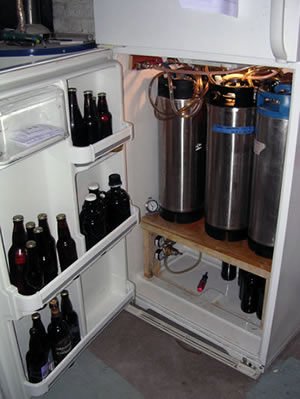
Full sized fridge-conversion style or chest freezer style kegerators supply plenty of room for cold conditioning, if you only have the patience to wait it out.

Related Projects :
Build a Home Brewing Kegerator Fermentation Chamber -- Build a kegerator fermentation chamber for the ideal storehouse for fermenting and lagering beers at different temperatures.
Building Your Own Fermentation Closet -- Keep your beer safe in a climate and light controlled environment and get tips on how to build a fermentation closet.
Secondary Fermentation -- Recommendations on secondary and tertiary fermentation for home brewers that want to take the next step in producing quality beers.

Published: July 18, 2011

For additional information on home brewing or homebrew topics please visit our home brewing article center.


Print Print     Email Post Email


advertisement


Join the American Brewers Association

Terms & Conditions
| Privacy Policy | Home | About Us | Contact Us | Site Map

HomeBrewing.com Facebook  HomeBrewing.com Twitter  HomeBrewing.com Pinterest  HomeBrewing.com RSS

© 2013 HomeBrewing.com - All Rights Reserved.